

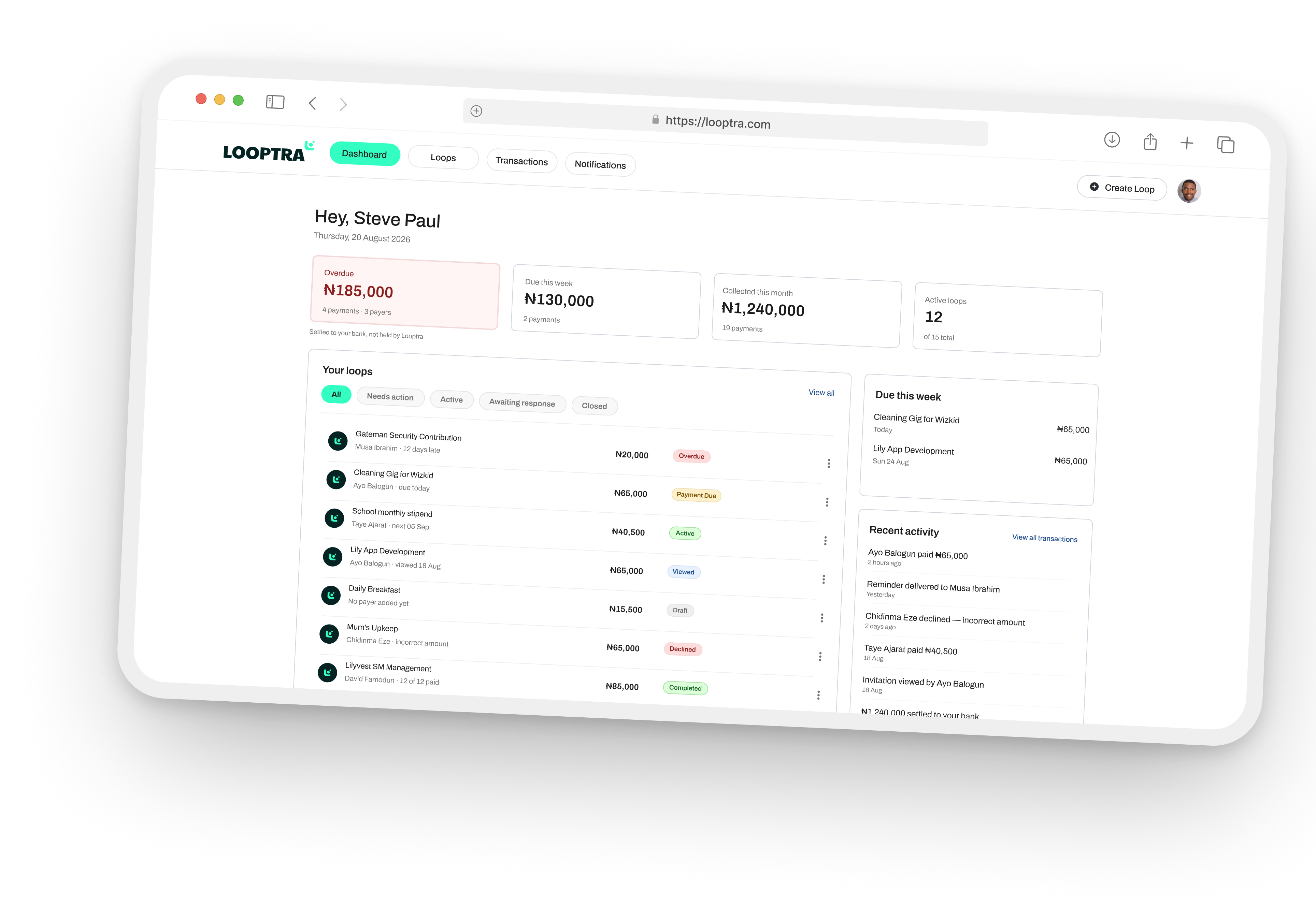
01 / COLLECTORS
I collect payments
For people who collect again and again.
Schools & tutors
Term fees and lesson payments.
Freelancers & agencies
Retainers and recurring services.
Property & instalment businesses
Rent and agreed payment plans.

Payments get buried in chats. Reminders feel awkward. Account details are too exposed and repeatedly sent. No one is entirely sure what's due, and the relationship suffers from the administrative friction.
A short film of a payment chase inside a phone: messages and follow-ups about money owed, without sound.
HOW IT WORKS
See the amount, the date and the next step—without chasing through separate messages.
01
Set the amount, dates and number of payments in a loop.
LOOPTRA / EXAMPLE
Tuition · First term
Amount
₦65,000
Schedule
Monthly · 3 payments
First payment · 15 January 2027
02
Send an invitation by an available channel. They can review it first.
LOOPTRA / EXAMPLE
Invite Ayo
A clear amount. A clear date.
One invitation to review.
Review invitation
03
The payer reviews the schedule, chooses reminders and authorises payment separately.
LOOPTRA / EXAMPLE
₦65,000 · Monthly
Payment reminders: optional
Automatic payments: authorisation required
Review & authorise
04
Looptra coordinates reminders and follow-ups. Track what is paid or still outstanding.
LOOPTRA / EXAMPLE
Before it’s due
Reminder scheduled
If it’s overdue
Follow-up scheduled
When paid
Receipt available
WHO LOOPTRA IS FOR
01 / COLLECTORS
For people who collect again and again.
Schools & tutors
Term fees and lesson payments.
Freelancers & agencies
Retainers and recurring services.
Property & instalment businesses
Rent and agreed payment plans.
02 / PAYERS
For people keeping up with an agreed commitment.
Parents & guardians
Know the fee, date and pupil it relates to.
Clients & tenants
Review what you’re being asked to pay.
People paying in instalments
See the schedule and choose your reminders.
You can collect in one loop and pay in another. Your role belongs to the relationship.
The payment is only one moment.
Looptra keeps the agreement, schedule, reminders, payment status, and next step clear for both people, from enrolment to the next cycle.
A short film on a dark plate showing how a collection cycle runs: enrolment once, then reminders, payment, and the next cycle — without sound.
An active payer is one person you are currently collecting from. Start with no subscription and a charge only when a payment succeeds, then move to a flat plan when the list grows.
Billing period
Prepay for longer and the total falls. Your billing period is separate from how often your payers pay, a termly subscription does not require termly payers.
Every plan in full, side by side. ✓ means the plan includes it; — means it does not.
| Feature | Starter | Solo | Business | Portfolio |
|---|---|---|---|---|
| What you pay | ||||
| Monthly subscription | ₦0 | ₦5,000 | ₦18,000 | ₦75,000 |
| Looptra service charge on payments | 1.5% of each successful payment · min ₦50, max ₦2,500 · you pay it | None | None | None |
| Your payment provider’s charge | Applies | Applies | Applies | Applies |
| Pass the provider’s charge to payers | — | ✓ | ✓ | ✓ |
| Extra active payers | — | — | +100 for ₦7,000 a month, up to 500 | +100 for ₦6,000 a month · custom above 3,000 |
| Capacity and collection schedules | ||||
| Active payers | 10 | 50 | 200 included | 750 included |
| Active loops | 2 | 10 | Unlimited | Unlimited |
| Processed each calendar month | ₦1.5m | Unlimited | Unlimited | Unlimited |
| Weekly, monthly, quarterly, termly and annual schedules | ✓ | ✓ | ✓ | ✓ |
| Daily, biweekly and custom schedules | — | ✓ | ✓ | ✓ |
| Instalments and partial payments | — | ✓ | ✓ | ✓ |
| Payment plans set per payer | — | — | ✓ | ✓ |
| USD loops for diaspora payers | — | — | ✓ | ✓ |
| Mark a payment as paid off-platform | 3 a month, marked unverified | ✓ | ✓ | ✓ |
| Reminders and payment tracking | ||||
| WhatsApp reminders per due payment | 2 | 3 | 4 | 5-step escalation |
| Email reminders | ✓ | ✓ | ✓ | ✓ |
| SMS fallback | — | — | ✓ | ✓ |
| Choose your own reminder timing | Fixed schedule | ✓ | ✓ | ✓ |
| Automatic escalation sequences | — | — | Basic | Full rules |
| Payment confirmation, status, receipts and history | ✓ | ✓ | ✓ | ✓ |
| Payer decline, correction request and consent controls | ✓ | ✓ | ✓ | ✓ |
| Dashboard history | 90 days | Full | Full | Full, plus portfolio roll-up |
| Late-fee automation | — | — | ✓ | ✓ |
| Imports, reconciliation and reporting | ||||
| Bulk invitations | — | ✓ | ✓ | ✓ |
| Bulk CSV payer import | — | — | ✓ | ✓ |
| Bank-statement reconciliation | — | — | ✓ | ✓ |
| Arrears tracking and debtor reports | — | — | ✓ | ✓ |
| Statements and exports | — | CSV | CSV and PDF | Owner and client statements |
| Scheduled reports | — | — | ✓ | ✓ |
| Analytics and collection forecasting | — | — | Basic trends | Forecasting and cohort arrears |
| Audit trail | — | — | 90 days | Full, exportable |
| Accounting integrations | — | — | CSV templates | ✓ |
| Team access and organisation | ||||
| Team seats | 1 | 1 | 3 included, up to 6 at ₦2,000 each | 10 included, more at ₦1,500 each |
| Roles and permissions | — | — | 3 roles | Custom roles, per entity |
| Payout bank accounts | 1 | 1 | 3 | Multiple |
| Separate estates, campuses or clients | 1 | 1 | 1 organisation, up to 3 | Unlimited client workspaces |
| Business CAC verification | Optional | Optional | Required | Required |
| Dedicated virtual account per payer | — | — | ✓ | ✓ |
| Branding, support and integrations | ||||
| Branding on invites and receipts | “Powered by Looptra” | Your logo and colours | Your email sender, no Looptra branding | White-label and custom domain |
| Payer portal | Receipt links | Receipt links | Full portal | Full branded portal |
| Broadcast announcements to payers | — | — | ✓ | ✓ |
| API and webhooks | — | — | — | ✓ |
| Support | Help centre and email, 72 hours | WhatsApp and email, 24 business hours | Priority, 8 business hours, plus an onboarding call | 4-hour response and a named account manager |
| Assisted onboarding and migration | — | — | ₦25,000 one-off | Included |
✓ included on this plan
— not on this plan
On Starter, 1.5% of each successful payment, at least ₦50 and never more than ₦2,500, and you pay it. On every paid plan that charge is removed. Your payment provider charges separately on all four plans.
FAQ
The short answers. The rest we go through with you.
A loop is the agreement, the schedule and the payment record in one place — who pays, how much, how often, and what has happened so far.
Payment partners are dependable and essential for completing payments. Looptra is designed and relied upon for keeping payment relationships in order.
Ready when you are
Create a Looptra account, add one payer you already collect from, and send the first invitation. You can decide about the other thirty-nine afterwards.
No card required to set up. Collector verification and a payout bank account are needed before you can receive money.